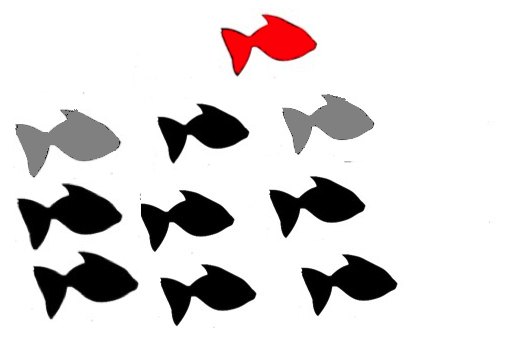
The following 2015 web article by Elizabeth Mika is a very balanced and excellent summary of Dąbrowski's Levels. Mika2015
In Dąbrowski's work, he separated level I into two primary
divisions, the lowest, characterized by the most rigid integration and the
higher division, characterized by strong integration and being represented
by the average person.
≻ Thus, for Dąbrowski, this was a large group.
≻ At the Florida conference, 2002, Dr. Kawczak indicated that
Dąbrowski said that about 85% of people were at Level I.
≻ I recall Dąbrowski saying that about 65% were at Level I and
that he felt that this was a tremendously positive feature as it meant
that about 35% of people were able to break out of this primary
integration and enter into higher development.
Quantification:
In the early days, Dąbrowski described the levels but did not number
them.
≻ Dąbrowski was initially against assigning numbers to the five
levels and had little interest in quantification; however, an empirical
approach was called for by the criteria of the Canada Council grants which
Dąbrowski used to pay the salaries and costs of the research team in
Edmonton (Dąbrowski, 1972b, p. vi).
Material collected from autobiographical and verbal responses was divided
into small sections called response units.
≻ To facilitate analysis, Piechowski (1975, p. 270) developed and
presented nine possible level values that reflected "the descriptions
of dynamism and definitions of levels."
≻ The nine levels were comprised of five main levels and four
"demi-levels" describing individuals between levels.
≻ This system was summarized in Piechowski (2008):
The first numerical assignments to the five levels appeared in print in Dąbrowski (1972b).
Heuristics:
Dąbrowski was very clear that the levels he presents "represent
a heuristic device" (his words) and he was always reminding us that
these levels and descriptions of people are conceptual abstractions.
≻ As such, there is no "average person" lurking around
waiting to be discovered.
≻ Nor is there an exemplar of any given level as such.
≻ On the other hand, in the vernacular of everyday language we do
talk about the Level I person and the Level V person, etc. as if they
exist.
Continua:
Dąbrowski used the levels and their descriptions to outline and
describe the conceptual prototypes of the different kinds or types of
humans that we see in life.
≻ He wanted his theory to be able to account for the lowest seen in
humans (as he personally observed in the Wars) and also for the highest
human actions and achievements as well.
≻ Dąbrowski said he tried to write a theory that would
"explain both the lowest acts we see in humans and at the same time
also the highest actions we see in humans."
≻ Dąbrowski felt that these diverse human behaviors could be
understood using a hierarchy of levels (a Platonic approach) and what he
called multilevelness.
≻ To this end, he described various continua of both integration and
disintegration (growth).
≻ I think it serves us to view the levels with this in mind.
Level I: Primary or primitive integration.
Represents a level characterized by varying degrees of integration.
≻ A continuum from severely integrated to moderately integrated to
loosely integrated.
≻ Dąbrowski referred to the most rigidly integrated individuals
as psychopaths (a small number of people) and the less integrated
individual as the average person.
≻ Dąbrowski placed both of these subtypes under Level I.
These quotes describe his approach: "A fairly high degree of primary
integration is present in the average person; a very high degree of
primary integration is present in the psychopath.
≻ The more cohesive the structure of primary integration, the less
the possibility of development; the greater the strength of autonomic
functioning, stereotypy, and habitual activity, the lower the level of
mental health" (Dąbrowski 1964, p.121).
"Individuals with some degree of primitive integration comprise the majority of society" (Dąbrowski 1964, p. 4).
"Among normal primitively integrated people, different degrees of cohesion of psychic structure can be distinguished" (Dąbrowski 1964, p. 66).
Level I is characterized by no or very little internal conflict.
≻ The individual is content that their actions are proper and they
do not experience inner conflicts over their values or their actions in
life.
≻ Thus, Level I is characterized as a harmonious level,
"ignorance is bliss."
Note: In her presentation at the conference in Florida, November 2002, Dr.
E. Mika said that in Dąbrowski's Polish works, he further
differentiates Level I into even more subtle sub-levels.
≻ She presents a nice graphic of this idea as follows:
From: http://www.hoagiesgifted.org/positive_disint.htm
As shown by the gray shading Dr. Mika used in her diagram, there are several shades of Level I, from the darker, more integrated, to the lighter shades of the less rigidly integrated, individuals who are more prone to "break" into Level II and possibly higher development.

Fleshing out a larger picture.
I would add color to Dr. Mika's diagram to show that Dąbrowski
emphasized both the quantitative and qualitative divergence of the
Multilevel levels from the lower unilevel levels.
≻ In this sense, there is a pretty clear line of demarcation between
Level II and III (between unilevel and multilevel).
≻ Multilevel is to unilevel as color is to black and white.
≻ Between III and IV and IV and V, there is less of a sharp line and
these levels tend to shade into one another – and they are
qualitatively similar to each other.

Michael Stone presented a similar approach in describing moral
development.
≻ Stone described a hierarchy of moral levels and illustrated
several pathways of development involving the interaction of genetics and
environment.
≻ As Stone illustrated, individuals with strong genetics will be
little impacted by environment, whereas, those with equivocal genetics
will be greatly influenced by environmental influences.

Here is another helpful visual.

Level II – unilevel disintegration:
This is the first level characterized by disintegration, the process
whereby development occurs – Development requires a breaking down of
the initial integration of Level I, usually through crisis: "Every
authentic creative process consists of 'loosening,' 'splitting' or
'smashing' the former reality.
≻ Every mental conflict is associated with disruption and pain;
every step forward in the direction of authentic existence is combined
with shocks, sorrows, suffering and distress" (Dąbrowski, 1973,
p. 14).
≻ And again, "we are human inasmuch as we experience disharmony
and dissatisfaction, inherent in the process of disintegration"
(Dąbrowski 1970, p. 122).
≻ Finally: "The term positive disintegration will be applied in
general to the process of transition from lower to higher, broader and
richer levels of mental functions.
≻ This transition requires a restructuring of mental functions"
(Dąbrowski 1970, p.18).
[Note: Dąbrowski uses a unique definition of personality and presents
a distinct approach to what constitutes a human individual.
≻ Individuals at lower levels are "not yet human" in
Dąbrowski's context and based on his definitions.
≻ Dąbrowski says "we are human inasmuch
… "
≻ For Dąbrowski, authentic human traits are associated with
autonomy (third factor) and are not yet seen at the first level, authentic
human traits only begin to emerge with disintegration and higher
development.
≻ In this context, many individuals at lower levels would be
described as not yet possessing human qualities.
≻ Dąbrowski goes so far as to use the expression
"anti-human."
≻ In Dąbrowski's terminology, personality is a term
reserved for individuals who have obtained a high degree of personal
autonomy, usually seen at Level IV and V.]
At Level II, the disintegrations are horizontal. "Internal conflicts
exist but are usually externalized.
≻ They lack a direction, they occur as if on one plane only (hence
called unilevel)" (Dąbrowski, 1970, p.111).
≻ This level is characterized by ambivalences (the person has no
real preference between choices and could choose one thing or another) and
ambitendencies (the person is pulled and pushed equally toward competing
choices and alternatives).
Dąbrowski said that Level II is a transitional level and it can not be tolerated for long: "Prolonged states of unilevel disintegration (Level II) end either in a reintegration at the former primitive level or in suicidal tendencies, or in a psychosis" (Dąbrowski 1970, p. 135).
Level III: Spontaneous Multilevel Disintegration:
≻ Two features distinguish Level III, It has
vertical conflicts
that signal
multilevelness
and they occur
spontaneously.
≻ Once Level III is achieved (multilevelness), the person can not
regress back into unilevelness or primary integration.
≻ Level III is the first level of vertical or multilevel conflict,
the real engine of human development because the contrast between lower
and higher conflicts suggests a developmental direction – vertical
development.
≻ Contrast this with conflicts at Level II – they are
horizontal and in this sense there is no developmental solution, one can
choose to go left or right but not up, this developmental choice is not
yet seen by the individual at Level II.
Multilevelness is characterized by two features: it is
quantitatively different
from unilevelness and it is also
qualitatively different
as well.
≻ So, to invoke Plato again, ML shows a difference of degree and of
quality that makes it unique – we do not just see
more,
we see life
differently.
Level IV: Organized Multilevel Disintegration:
The major feature distinguishing this level is the operation of the third
factor and the increased role of the self in development.
≻ Conflicts are no longer driven by life experiences (and thus are
spontaneous), the individual comes to volitionally and actively seek out
contradictions in life and in their own value structure and behaviour.
≻ Dąbrowski also called this level
"Directed"
Multilevel Disintegration.
Level V: Secondary Integration:
The distinguishing feature of Level V is a harmonious integration.
≻ The conflicts of development are over and the individual is
content in their self and in their personality ideal.
≻ The person is fully human and possessing a unique individual
personality.
≻ Their internal conflict is gone because they are confident in
their chosen value hierarchy, in their chosen hierarchy of aims (goals)
and their behavior conforms to this value structure.
≻ Internal vertical conflicts have stopped. External conflicts are
met with a positive and developmental orientation.
Development is uncommon:
The sequence of transformations "occur only if the developmental
forces are sufficiently strong and not impeded by unfavorable external
circumstances.
≻ This is, however, rarely the case. The number of people who
complete the full course of development and attain the level of secondary
integration is limited.
≻ A vast majority of people either do not break down their primitive
integration at all, or after a relatively short period of disintegration,
usually experienced at the time of adolescence and early youth, end in a
reintegration at the former level or in partial integration of some of the
functions at slightly higher levels, without a transformation of the whole
mental structure" (Dąbrowski 1970, p. 4).